Find English Reading
Materials to Meet Your Needs
Finding English reading materials that you understand and enjoy.is the best way to motivate yourself to read a lot in English-- and extensive reading is important for building your English vocabulary and fluency.
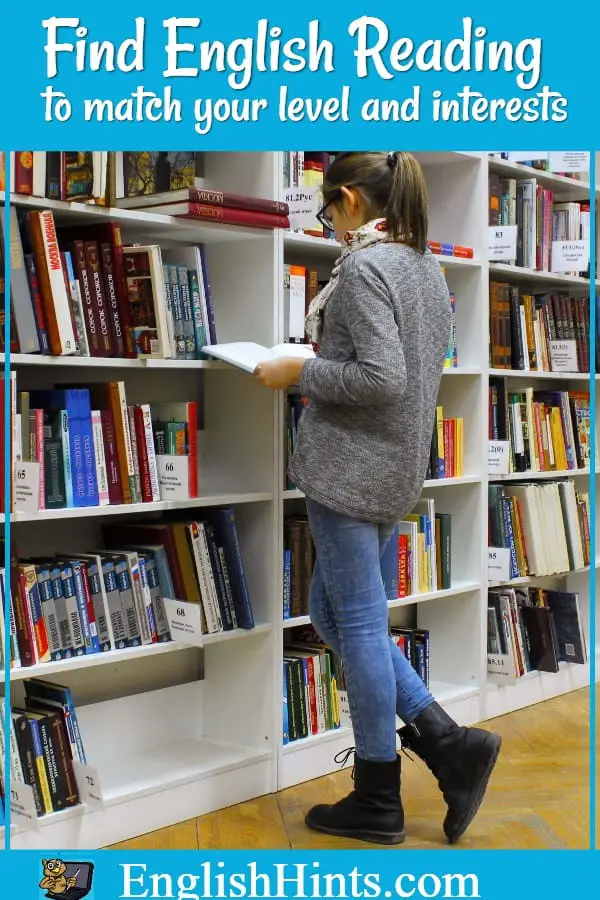
It's good to read selections that exercise your mind, but don't choose readings that are too hard.
It's important to understand what you read without stopping too often to look up words. The more you read in English, the easier that will be!
Are you looking for English reading materials matching your interests and reading level? This page can help you find them.
(If you are only starting to read English, see Easy Reading for ESL Beginners instead.) The rest of this page has suggestions for high intermediate or advanced-level readings.
You're lucky if you have access to a library with books and magazines in English. Find a section or two with subjects that you enjoy. Read several articles or short books on the same subject. so you are likely to see some of the same words several times.
You can also find lots of magazines and articles on almost any subject online. (See Online Reading for some suggestions.)
Studying similar information in different sources will reinforce the vocabulary and ideas you are learning. Research shows people usually need to see or hear a word six or more times to learn it well.
Reading it in different contexts will also show you if it has different uses. You will learn its connotations (the feelings it implies).
To reinforce the vocabulary even more, write yourself a note about what you have read, or talk about it with a friend.
You might even start a book club. Read the same English-language book or article as your friends. Then you could have a great time being together-- and learning English!
Recommendations for Children's Books
Reading a book in another language can be a major project. That's why I suggest trying a few great children’s or young adult books even if you read English at a high intermediate level.
Most libraries have a collection of YA (young adult) books that are short or medium length. Many are high interest whether you are in your teens, 20s, 30s, or above. (I worked at a library for several years and am recommending only the best here.)
You can read several short children's or young adult books in the time it would take to read one adult book. They often equal the best adult books in accuracy, imagination, characters, and plot.
Look at books that have won the Caldecott (picture books) and Newbery awards. They're the best-of-the-best of American children’s books. For the Caldecotts, see the English Reading Practice for Beginners page linked above. They're all worth considering for yourself, as well as for reading to your children (if you have any).
Newbery winners are written for older children (8-12) and teens. (I’ve read many of them as an adult, some aloud to my daughter and some on my own. I’ve enjoyed many of them as much as really good “adult” books.)
Here are a few I highly recommend to adults as well as kids. They give vivid pictures of other places and times:
- Number the Stars by Lois Lowry,
- Hunger Games by Suzanne Collins,
- Sarah, Plain and Tall by Patricia MacLachlan,
- Julie of the Wolves and My Side of the Mountain by Jean Craighead George,
- Island of the Blue Dolphins and others by Scott O’Dell,
- The Witch of Blackbird Pond by Elizabeth George Speare,
- The Good Master and others by Kate Seredy,
- Esperanza Rising by Pam Munoz Ryan,
- and my personal favorite (a science fiction/fantasy) A Wrinkle in Time and its sequels by Madeline L’Engle.
People the world over have loved The Little House on the Prairie and its sequels by Laura Ingalls Wilder. The series brings to life pioneer self-sufficiency-- and a wonderful family.
Also try some of the British children’s classics like:
- Treasure Island by Robert Louis Stevenson,
- The Secret Garden by Frances Hodgson Burnett,
- and The Chronicles of Narnia by C.S. Lewis.
You can read reviews (or order these books) online. Ask a librarian for other recommendations.
High-Interest, Low-Difficulty Books for Teens
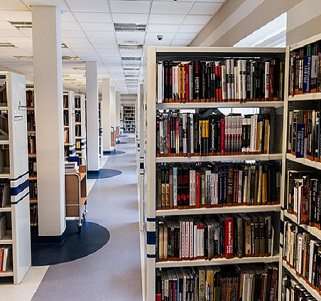 A library has many types of English reading materials-- something for everyone!
Some of the best books are written for teen and young adult readers.
A librarian will be able to show you fascinating books on almost any subject.
If you find them hard, there are also "high interest, low difficulty" books. (Try magazines and short stories too.)
For ideas, see the themed booklists on the Adlit site. They have about forty different lists. Each list has short descriptions for some excellent but easier books on that theme.
English Reading Materials and Books for Adults
There is a world of knowledge and interest awaiting you in books written for adults, as well. For classic "light" (recreational) English reading, consider To Kill A Mockingbird by Harper Lee and Animal Farm by George Orwell or books in the different genres below.
For non-fiction, more recent selections, or current bestsellers, talk to a librarian. You can also check the New York Times Book Review. It lists and discusses the best in current American fiction and non-fiction. (Most of them will be difficult until you read at high intermediate level or above, though.)
Authors to try for different genres (types) of fiction:
- For westerns, try books by Louis L’Amour or Zane Grey.
- For science fiction, try Robert Heinlein, Ray Bradbury, or Isaac Asimov. (I have really enjoyed books by Orson Scott Card : Ender’s Game & its sequels.)
- For humor, try Three men in a boat by Jerome K. Jerome (a classic), or books by James Thurber, P.G. Wodehouse, or Mark Twain.
(Humor in a different language and culture can be difficult to understand. It often relies on subtle language differences or on shared cultural values.
Don't fret if you don't find some of these authors funny. Try another author --some kinds of humor are universal-- or choose a different kind of reading.)
- For romance, you might start with books by Norah Roberts, Mary Stewart, Catherine Cookson, or Victoria Holt.
- For suspense, try John Grisham, Tom Clancy, Mary Higgins Clark, Robin Cook, Michael Crichton, or Ken Follett.
- For mysteries, start with classic authors like Sir Arthur Conan Doyle (Sherlock Holmes) and Agatha Christie. You might try John D. McDonald, Dorothy Sayers, or Ellis Peters.
A few who write unusual mysteries, with humor, likeable characters, and a special twist:
- Lilian Jackson Braun ("The Cat Who” series-- a cat finds crucial clues),
- Susan Wittig Albert (whose main character is an herbalist and ex-lawyer),
- Tony Hillerman writes about Navajo culture and two Navajo Tribal Policemen,
- Robert Van Gulik created Judge Dee, an ancient Chinese magistrate based on Chinese literature.
Home> Reading Comprehension Skills and Strategies > Find English Reading Materials.
Didn't find what you
needed? Explain what you want in the search box below.
(For example, cognates, past tense practice, or 'get along with.') Click to see the related pages on EnglishHints.
| site search by freefind | advanced |


What's New?-- site blog
Learn about new and updated pages on EnglishHints, with just enough information to decide if you want to read more.
Do you already use English in your profession or studies-- but realize you need more advanced English or communication skills in certain areas?
I can help-- with targeted suggestions & practice on EnglishHints or with coaching or specialized help for faster results. Let me know. I can suggest resources or we can arrange a call.
Vocabulary in Minutes a Month
Sign up for our free newsletter, English Detective. In a few minutes twice a month you can:
- Improve your reading fluency with selected articles & talks on one subject (for repeated use of key words)
- Understand and practice those words using explanations, crosswords, and more
- Feel more confident about your English reading and vocab. skills-- and more prepared for big tests & challenges
For information (and a free bonus), see Building Vocabulary


Home | About me | Privacy Policy | Contact me | Affiliate Disclosure
Copyright © 2011 – EnglishHints.com