How to Build a Weekly English Study Schedule That Fits
Your Energy and Work Life
A realistic weekly English study schedule starts with what your week actually looks like, not the perfect routine you wish you had. Focus on your strongest energy windows, choose 1–2 weak spots, and build a minimum version for busy weeks. What works will vary depending on your workload and confidence level, so the flexible guide below can help you plan your week, allow time for speaking practice, and adjust without needing to start over.
Build a Week You Can Actually Repeat

It’s so easy to look for a “perfect” study plan that promises quick progress. The problem is that so often something goes wrong. You aren’t feeling well, or one of your children needs extra help. Maybe you get home from work very late or have a presentation to give that needs to be reworked. We have an English saying: “life gets in the way.” You can expect something “unexpected” to happen frequently.
So don’t plan on doing everything “right” every week—and end feeling discouraged and maybe giving up. That’s why it’s important to be flexible, and to find ways to spread the necessary practice throughout the days of the week. That way even in a difficult week you can at least find a few chances to practice the skills you need most. Then you don’t need to feel you’ve failed! You’ve made progress this week, and if next week allows, you can make even more.
Research shows that successful study plans are designed to be convenient and to use simple reminders and routines rather than depending on enthusiasm to keep going.
The goal is steady progress, not ideal consistency.
Find Your Best Times for English Before You Choose Tasks
Think about the possible time slots in your daily and weekly English study schedule.schedule. When would it be possible to study English for a few minutes? Could you find an opportunity before work (or even on your way to work)? What about during lunch or another break?
When might you be able to study for a few minutes after you get home, after the evening meal, or before bed?
Once you know what’s possible, consider your energy levels.
Do your best to choose a high-energy time to practice speaking in English.
You certainly need time to relax, time for your family, and time for meals and meal preparation, clean-up, and chores. But most of them don’t require as much focus and energy as you need to combine the pronunciation, vocabulary, grammar, and critical thinking skills that will enable you speak effectively in English (or any language you are still learning.)
So, can you reserve a few minutes of your best energy time to dedicate to English speaking practice?
Mark Your High-Focus, Medium-Focus, and Tired Time Blocks
Think about the times each day when you feel the sharpest and most focused. Mark your calendar to block out some of that time for the English study that requires your highest concentration—probably including planning and practicing for subjects you’ll need to discuss in English.
Choose your most important English areas to protect first. Then plan the less energetically-critical parts of your weekly schedule, including meals, household duties, and relaxing with family or a little time for yourself.
Most other English study can also fit in the medium-focus times. Chores that don’t require much thought, and some relaxation, can fit in the times when you are more tired.
You know your own strengths, difficult areas, and energy rhythms best, so use your own judgment—but planning based on your energy may make a huge difference in how effective your English study will be. It may even make the difference between being able to keep studying or giving up after a few weeks.
Choose the English “Weak Spots” that Actually Need the Most Work
If you schedule everything you hope to study in English, you won’t be able to give enough time to the skills that could really make a difference for you. So set priorities. Here’s how:
Start with what Affects Your Real Life Most

Is there any English skill that matters for your work right now, or could prepare you for a promotion or job you hope to get soon? That can bring you immediate results!
Do you already use English at work sometimes—and notice that colleagues don’t understand you. Having a non-native accent doesn’t matter, but you need to find out if your pronunciation is confusing them or what else the problem might be.
If you are having trouble understanding their English, try listening to English talks, videos or podcasts. You might listen the first time with transcripts or subtitles to check if you understood their meaning, but try listening again to find out if you can understand it on your own the second or third time.
If it feels like everyone speaks too fast, try adjusting the speed of recordings. In fact, sometimes speeding a recording up the first time you listen may help. It makes listening the second time at its natural speed feel easier!
Listening to short sections of videos, podcasts, or TED talks on subjects you enjoy can also help with pronunciation practice. Try shadowing: playing a sentence or two, stopping the recording, and repeating what you heard as accurately as you can. Once you have done this for a while, you can record yourself as you “shadow” (imitate what you heard.) How close did your pronunciation come to the person you copied?
Don’t Give Every Skill Equal Time
Avoid the trap of spending much of your time on activities that feel familiar or less demanding (reading, watching videos, even grammar practice if you’ve already worked on it a lot.) If there is a particular grammar error you think may make often, especially if it confuses others, work on that. But don’t focus on perfecting your grammar. For most people, that isn’t a real block to communication. If you only make mistakes occasionally, it probably doesn’t matter at all.
Language learning research suggests that you should start with whatever weakness limits your ability to speak or understand clearly the most, whether it is also your weakest skill or not.
Here’s a useful ranking:
1. Frequency of use: What skill do you need daily?
Example: If you’re a manager who leads meetings in English, your priority is likely to be speaking and/or listening.
2. Communication impact: Which problem causes misunderstandings?
Examples:
- unclear pronunciation
- inability to organize ideas
- limited vocabulary for professional topics
3. Transferability: Which improvement helps many situations?
- Key phrases and discourse markers (“however,” “from my perspective”)
- vocabulary chunks
- pronunciation of common words
Rare grammar points are probably useful much less often.
4. Frustrating situations: Start with what bothers you most or prevents you from reaching your goals.
Pick One Main Weak Spot and One Support Area
Start with the weak spot that is hindering you the most right now. Add one (or at most two) support areas.
For example, several of my students have been able to understand scientific articles in English well, but still hesitated to speak up in meetings because they feared they wouldn’t remember the words they needed at the moment the started speaking or because they lacked confidence in their pronunciation.
They didn’t need to work on vocabulary, but on practice: speaking briefly in English over and over until it felt so ordinary they were no longer as nervous—and until they were confident that they could find another way to express a thought when they couldn’t immediately think of the word they wanted.
In addition to speaking practice, some focused on planning ahead for topics they knew would come up in meetings soon.
Others, with more questions about their pronunciation, listened to English talks that interested them. (Work-related podcasts are another way to listen to a lot of English on subjects you might later want to discuss.)
Match each English Activity to the Right Energy Level
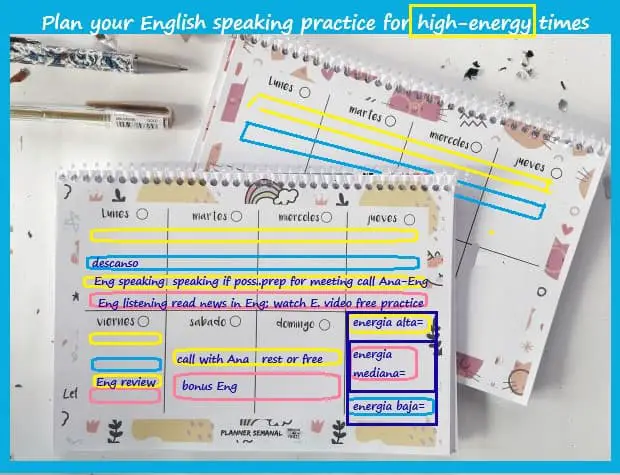
Now match the the weak area and support area tasks you most want to work on this week with the energy levels they need.
For example, if you want to work on speaking and listening skills, you might spend 20 minutes of medium energy time, possibly (depending on your own energy levels) after supper on Monday listening to a podcast on a topic related to your work on Monday evening.
Tuesday evening you might again spend 15-20 minutes making notes about what you might say at a meeting on a project update you have Thursday. On Wednesday you could choose your highest energy time to actually practice speaking about that project once or twice, using your notes if needed—and if you have time answering a possible question or two about your idea.
Thursday after the actual meeting, relax with some interesting English listening at a lower energy time. Then on Friday, find a medium-energy-time level time to think over how the practice and your actual comments at work went and what you might work on next week. Be sure to recognize what you did well, not just areas that still need more practice!
Build your minimum week, normal week, and extra-English
week
You probably noticed that the plan I suggested above was quite minimal (about 20 minutes a day each workday, or an hour total). I wanted to show that it’s possible to keep working on your English needs even with very limited time, when there is extra work or family pressure.
You can make faster progress if you can spend thirty-forty minutes most days, possibly split between high- and medium-energy times, or if you can sometimes use commute times or weekends. The key is to be flexible, and do what you can. See if you can practice speaking English on a call with a friend once a week. If you know you are weak on certain grammar points or tenses, you can ad those (one or two at a time) as the supporting practice for a week.
If there’s an activity you enjoy in English, add that whenever you have extra time, even if it’s not your most urgent need. Do you like word games or crosswords in English, or reading English detective stories? (If you have young children, they might like listening to picture books in English and pointing to the animals or characters as you read about them. If your older children have learned a little English, try playing 20 Questions or Odd One Out with them.) Whatever gets you thinking in English will move you forward!
The Lowest-Friction Speaking Practices
These low-pressure speaking practices can preserve your momentum during stressful weeks and expand your fluency and confidence when you have time for a little more. Add a few minutes a week doing any of these to improve your speaking fluency and confidence
- Talk to yourself out loud in English when you’re alone: name what’s going on and how you feel about it while driving, doing chores, etc.
- Read or listen to something short and then explain it out loud. Examples: summarize an article or a work email or describe a process. If you have a good friend you can talk to in English, that’s even better.
- Once a week, make a one or two-minute recording to explain one challenge you faced today. After a few weeks, compare the recording. You’ll see improvement and feel less anxiety speaking as you keep doing this.
- Practice common professional scenarios like
> introducing yourself
> explaining your role
> giving an opinion
> disagreeing politely
> asking clarification questions
This practice connects directly to everyday needs.
- ·When shadowing, adapt what you hear instead of just repeating it. Example:
· Original: “The main issue we need to address is…”
· Adaptation: “The main concern my team needs to address is…”
- Enlarging your answer:
Example: Question: “What are the advantages of remote work?”
Answer the question three times, for30 seconds, then 60 seconds, then 2 minutes, to help you expand your answer and English fluency.
The more short speaking practice you will actually do, the better, especially when it is related even slightly to your work. Research shows clearly that, especially for speaking, brief, frequent practice (15-20 minutes) four to five times a week is worth more than 3 hours once a week, even though total time is much less.
Review Your Week in 5 Minutes and Plan the Next One
Ask yourself:
- What became easier this week, or helped you make progress?
- What looked good but didn’t happen?
- Was there a repeated problem with communication?
- What should you shrink, move, or protect next week?
- Is there a new weak area you want to work on or one most important skill?
Consider keeping a speaking log. Don’t count how many minutes you spent, but the skills you practiced. For example, “I explained my project update without translating.”
Keep useful evidence:
- recordings
- corrected phrases
- new expressions used successfully
Those are worth celebrating!
FAQs about Your Weekly English Study Schedule
How many days a week should I study English if I work full time?
Aim for consistency first: fewer days you actually keep beats an “ideal” schedule you drop. Five-six is good most weeks, if you can.
How many minutes per day should I study English (realistically)?
Pick a minimum you can do on busy days, then add longer sessions only when you have energy. Try for at least 15-20 minutes a day—counting thinking time in the shower or when folding clothes if that’s all you can find on very tight days.
Should I study one skill per day (grammar/vocabulary/reading), or mix skills every day?
Either works, but a couple skills you need right now are better than time spread between less urgent skills. Choose the structure you’ll stick with, then add a weekly review loop.
How can I include sentence structure and tenses practice in a weekly plan?
Use short, targeted practice tied to errors you actually make, then apply it in writing or speaking.
How do I practice speaking when I’m tired after work?
Give yourself a little break—or maybe a short walk. (The walk can even serve as English practice if you think about what you’re seeing in English—and maybe even comment on it out loud if you are alone.)
After that, do you have enough energy for 15-20 minutes of a low-friction speaking activity? (See the low-friction practice ideas above.)
If you are still too tired, and your evening chores leave you no time or strength for speaking, would it be possible to find 15-20 minutes on your lunch break, traveling to or from work, or even arriving at work a few minutes early? Take advantage of times when you have even a little more energy. It doesn’t need to be the same time every day. Just look for short chances to try speaking in English when you can—at least two to three times a week.
What should I do if I miss my plan for a whole week?
Don’t give up on it, but don’t be too hard on yourself either! Family, work, and health pressures are sometimes too much for even the most disciplined people—and sometimes we just need a little break. The key is to keep it little. Take a mini-vacation if you need to, but try to get back your minimum or light English study schedule the next Monday. Just managing 15 minutes a day will keep you from losing momentum or forgetting what you were working on.
So, get back to it as quickly as possible. Do at least the minimum you planned, even if it’s just 15 minutes each day trying a speaking exercise or other practice you planned for difficult weeks. And don’t skip your 5-minute weekly review, including a couple minutes thinking about how you can keep going during future “crunch” times.
How do I include review in a weekly English study schedule (so I don’t forget what I have studied)?
Schedule short review sessions every week, maybe Friday or Saturday. Use simple self-checks that don’t take long and that consider comprehension, accuracy, and recall. You can review vocabulary, re-do a short practice item, and set next week’s focus.
Home > Learning English Online > Build a Weekly English Study Schedule
Didn't find what you
needed? Explain what you want in the search box below.
(For example, cognates, past tense practice, or 'get along with.') Click to see the related pages on EnglishHints.
| site search by freefind | advanced |



What's New?-- site blog
Learn about new and updated pages on EnglishHints, with just enough information to decide if you want to read more.

Do you already use English in your profession or studies-- but realize you need more advanced English or communication skills in certain areas?
I can help-- with targeted suggestions & practice on EnglishHints or with coaching or specialized help for faster results. Let me know. I can suggest resources or we can arrange a call.
Vocabulary in Minutes a Month
Sign up for our free newsletter, English Detective. In a few minutes twice a month you can:
- Improve your reading fluency with selected articles & talks on one subject (for repeated use of key words)
- Understand and practice those words using explanations, crosswords, and more
- Feel more confident about your English reading and vocab. skills-- and more prepared for big tests & challenges
For information (and a free bonus), see Building Vocabulary


Home | About me | Privacy Policy | Contact me | Affiliate Disclosure
Copyright © 2011 – EnglishHints.com