Match These Idioms from Shakespeare with their Meanings
Some of the most colorful and expressive phrases in English are idioms from Shakespeare. We still use many of them in everyday conversation.
They are like a shorthand way of expressing some of our deeply-held beliefs about human nature and experience. That makes them important (though often not easy) to understand.
Idioms from Shakespeare Still Used Today
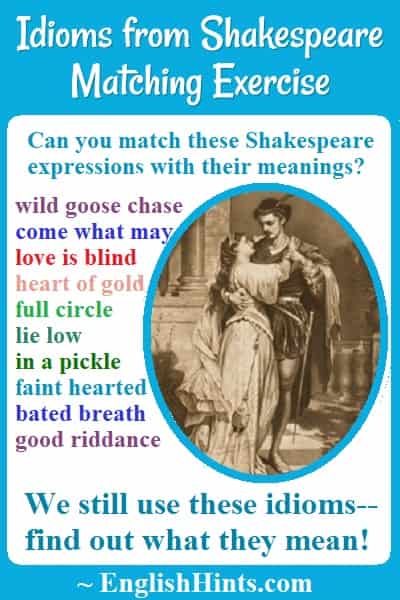
I used an infographic of Shakespeare idioms that is no longer available to make the matching game below
Shakespeare did not invent all of these expressions. Sometimes he ‘borrowed’ colorful phrases he heard or read. However, he is the first written source for most of them, and he made them popular.
People found many of them useful ways to express their feelings or experiences, and so many of them are familiar to most native English speakers—a part of our heritage and our thinking patterns.
Here are a few examples (mostly too long to fit in a matching exercise on this page):
- "To wear your heart on your sleeve" means that your feelings are obvious to everyone.
- "The world is my oyster" means that I'll find a way to get what I want.
- A "laughingstock" has done somethig so foolish everyone makes fun of him.
- :Something that "makes your hair stand on end" is very frightening.
- If something "sets my teeth on edge" it irritates or bothers me.
Try the matching game below to see how many more of these common expressions you can guess.
(If you would rather download the game and use it at home or in a classroom, right-click this link to a pdf version-- in a different order. The first page has tios for teachers, but followed by the matching exercise, answers, and a few notes. )
Can You Guess the Meaning of these Shakespeare Idioms?

Match the Shakespeare idioms and expressions on the left with their meanings on the right.
(The first one has been done for you.)
| wild goose chase | ||
| break the ice | ||
| full circle | ||
| heart of gold | ||
| faint-hearted | ||
| love is blind | ||
| bated breath | ||
| in a pickle | ||
| so-so | ||
| lie low | ||
| come what may | ||
| good riddance | ||
| the green-eyed monster |
More Background (if You're Interested)
*to get rid" of means to throw away or put out of our home and life. If someone has been in a difficult romantic relationship and his or her partner leaves, he or she may say “Good riddance! ”
**In English we still talk about being “green with envy” (an expression used by American writer Mark Twain over 100 years ago), but the idea goes back at least as far as the ancient Greeks. Shakespeare used “green-eyed jealousy” in The Merchant of Venice, but it became a monster in Othello. Iago warned Othello in act 3, scene 3.
“O, beware, my lord, of jealousy; It is the green-ey'd monster, which doth mock The meat it feeds on.”
Iago actually hated Othello and was trying to make him jealous. Iago created the green-eyed monster that led Othello to suspect and kill his wife—and then himself when he learned she was innocent.
Shakespeare’s plays are full of powerful insights into human psychology and creative ways to express them. If you’re wondering which one to try, look at the BBC’s short summaries. (They’re written as if they were headlines in a scandal-loving tabloid newspaper.)
For ideas on how to teach Shakespeare to students still learning English (using the above resources and more) see the British Council's suggestions.
A costume site page with more interesting background on Shakespeare was recommended by community arts center director Terry Kelly and her daughter Alexa. (I've had to remove other suggested links because they no longer work-- sorry.)
My thanks to Jen Maloney and her class for wanting to share what they found useful!
Home> Common Idioms> Idioms from Shakespeare.
Didn't find what you
needed? Explain what you want in the search box below.
(For example, cognates, past tense practice, or 'get along with.') Click to see the related pages on EnglishHints.
| site search by freefind | advanced |



What's New?-- site blog
Learn about new and updated pages on EnglishHints, with just enough information to decide if you want to read more.
Do you already use English in your profession or studies-- but realize you need more advanced English or communication skills in certain areas?
I can help-- with targeted suggestions & practice on EnglishHints or with coaching or specialized help for faster results. Let me know. I can suggest resources or we can arrange a call.
Vocabulary in Minutes a Month
Sign up for our free newsletter, English Detective. In a few minutes twice a month you can:
- Improve your reading fluency with selected articles & talks on one subject (for repeated use of key words)
- Understand and practice those words using explanations, crosswords, and more
- Feel more confident about your English reading and vocab. skills-- and more prepared for big tests & challenges
For information (and a free bonus), see Building Vocabulary


Home | About me | Privacy Policy | Contact me | Affiliate Disclosure
Copyright © 2011 – EnglishHints.com